
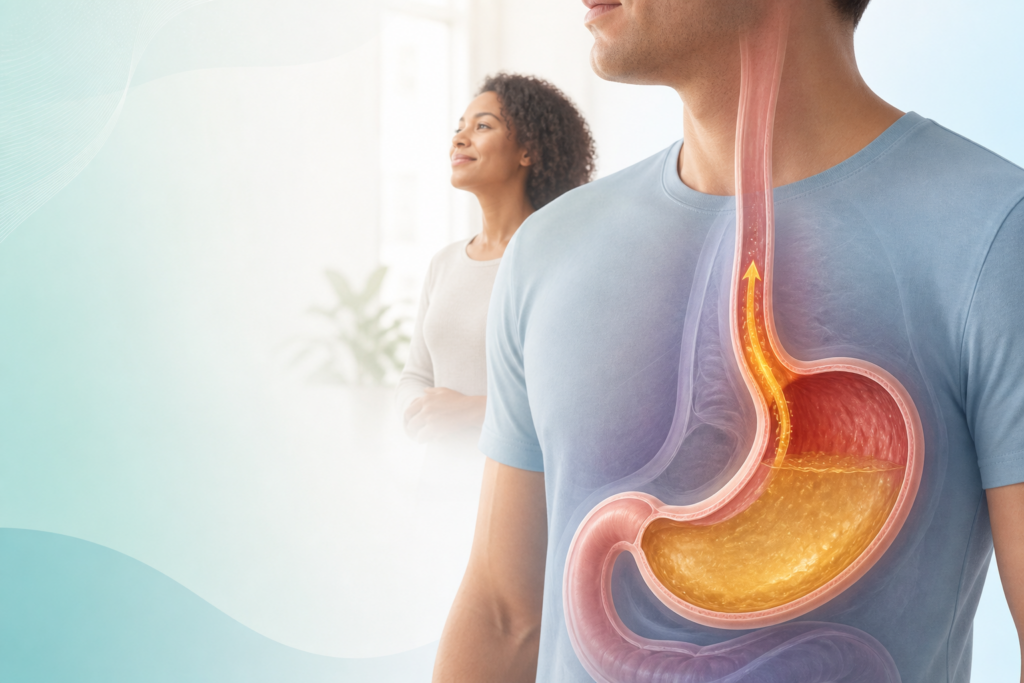
That burning feeling after a large meal may seem harmless. Occasional acid reflux is common, but symptoms that keep returning, interrupt sleep, or require frequent medication may indicate gastroesophageal reflux disease, commonly called GERD.
Understanding the difference can help you know when simple changes may be enough—and when it is time to consult a gastroenterologist.
What is acid reflux?
Acid reflux occurs when stomach contents travel backward into the esophagus, the tube connecting your mouth to your stomach.
A ring of muscle at the bottom of the esophagus normally acts as a valve. It opens to allow food into the stomach and then closes. If this valve relaxes when it should not or does not close properly, stomach contents can move upward and irritate the esophagus.
Occasional reflux does not necessarily mean you have a disease. GERD describes reflux that repeatedly causes troublesome symptoms or complications.
Common symptoms of GERD
Heartburn is the best-known symptom. It usually feels like burning or discomfort behind the breastbone and may become worse after eating, bending over, or lying down.
Other possible symptoms include:
- Sour or bitter-tasting fluid coming into the mouth
- Regurgitation of food or liquid
- Upper abdominal or chest discomfort
- Difficulty swallowing
- A sensation that food is sticking
- Frequent belching
- Nausea
- Chronic cough
- Hoarseness or throat irritation
- Symptoms that become worse at night
- Sleep disruption caused by reflux
These symptoms can have causes other than GERD. A medical evaluation may be needed when symptoms are persistent, unusual, or unresponsive to treatment.
When heartburn needs medical attention
Arrange a medical evaluation if:
- Heartburn or regurgitation happens repeatedly
- Symptoms regularly disturb your sleep
- You frequently depend on over-the-counter heartburn medicine
- Symptoms continue despite lifestyle changes or medication
- You have trouble or pain when swallowing
- Food feels stuck after you swallow
- You have persistent vomiting
- You experience unexplained weight loss
- You develop unexplained anemia
- You notice black, tarry stools
- You vomit blood or material resembling coffee grounds
Chest pain should not automatically be attributed to heartburn. Heart and esophageal symptoms can feel similar. Seek emergency assistance for new, severe, or unexplained chest pain—especially when accompanied by shortness of breath, sweating, dizziness, nausea, or pain spreading to the arm, back, neck, or jaw.
What can trigger reflux?
Triggers vary from one person to another. Common contributors may include:
- Large meals
- Eating close to bedtime
- Lying down soon after eating
- Alcohol
- Tobacco use
- Coffee and other caffeinated drinks
- Carbonated beverages
- Chocolate
- Mint
- Tomato-based or acidic foods
- Spicy foods
- High-fat meals
- Excess body weight
- Pregnancy
- Certain medications
You do not necessarily need to eliminate every food commonly associated with reflux. A symptom diary can help identify which foods, meal sizes, activities, or times of day consistently affect you.
Steps that may reduce reflux
Depending on your symptoms and overall health, a physician may recommend measures such as:
Avoid lying down soon after eating
Finishing meals at least three hours before lying down or going to bed may improve nighttime symptoms.
Adjust meal size
Smaller meals may place less pressure on the stomach than very large meals.
Identify personal triggers
Track what you eat and when symptoms occur. Focus on triggers that repeatedly affect you instead of following an unnecessarily restrictive diet.
Elevate your upper body at night
For nighttime reflux, raising the head and upper body with an appropriate wedge or bed elevation may help. Simply adding ordinary pillows may not provide the same consistent elevation.
Work toward a healthy weight
If you have overweight or obesity, medically appropriate weight loss may reduce pressure within the abdomen and improve reflux symptoms.
Avoid tobacco
Smoking can contribute to reflux and creates many additional health risks. Ask your healthcare provider for help developing a cessation plan.
How is GERD evaluated?
Many people can initially be evaluated based on their symptoms and medical history. Testing is not required in every case.
Further evaluation may be recommended when symptoms do not improve, the diagnosis is uncertain, or warning signs are present.
Testing may include:
Upper endoscopy
During an upper endoscopy, also called an EGD, a gastroenterologist passes a thin, flexible instrument with a camera through the mouth to examine the esophagus, stomach, and first portion of the small intestine.
An EGD can help identify inflammation, ulcers, narrowing, bleeding, Barrett’s esophagus, or another explanation for the symptoms. Tissue samples can be taken when medically appropriate.
Reflux monitoring
Esophageal pH monitoring measures how often stomach acid enters the esophagus. Some systems use a thin catheter, while others use a small wireless capsule temporarily attached during an endoscopy.
Esophageal manometry
Manometry measures the muscle contractions and coordination involved in swallowing. It may be useful when swallowing problems are present or before certain reflux procedures.
Your gastroenterologist will determine whether any of these tests are appropriate for you.
How is GERD treated?
Treatment depends on symptom severity, frequency, medical history, and whether complications are present.
Options may include:
- Lifestyle and dietary changes
- Antacids for occasional, mild symptoms
- H2 blockers that reduce stomach-acid production
- Proton pump inhibitors, or PPIs
- Additional diagnostic testing
- Endoscopic or surgical treatment in carefully selected cases
Although many reflux medications are available without a prescription, frequent or prolonged self-treatment deserves medical review. A physician can confirm whether GERD is the likely cause, determine the appropriate medication and duration, and evaluate whether additional testing is needed.
Do not stop a prescribed reflux medicine without discussing it with the prescribing clinician.
Why persistent GERD should not be ignored
Repeated acid exposure can injure the esophagus. Potential complications include:
- Esophagitis, or inflammation of the esophagus
- Ulcers or bleeding
- Scar-related narrowing called an esophageal stricture
- Difficulty swallowing
- Barrett’s esophagus, a change in the esophageal lining associated with an increased risk of esophageal cancer
Most people with GERD will not develop every complication. Appropriate evaluation and treatment can relieve symptoms and help protect the esophagus.
Get help for persistent heartburn or reflux
If heartburn, regurgitation, swallowing difficulty, or other upper digestive symptoms are affecting your daily life, it may be time for a gastroenterology evaluation.
Colon Liver Gastro Consultants provides evaluation and treatment for digestive conditions at convenient locations serving Sugar Land, Katy/West Houston, and Richmond.
Call (281) 565-1009 or request an appointment online.
This article is intended for general educational purposes only and is not a substitute for professional medical advice, diagnosis, or treatment. Contact a qualified healthcare professional about your individual symptoms. Call 911 or seek emergency care for potentially life-threatening symptoms.
Sources: American College of Gastroenterology, American Society for Gastrointestinal Endoscopy, and National Institute of Diabetes and Digestive and Kidney Diseases.